

What does Off Beat actually want to achieve for young people with AFib?
Someone asked me that question in a DM today. It’s a fair question, and one I should probably answer more publicly.
It started with a feeling
Spend any time in AFib communities online and you’ll notice two things. There’s a lot of fear. A lot of “this has ruined my life” and “I don’t know how to cope.” That’s real. A diagnosis of AFib in your 20s, 30s or 40s (or even teens!), with no clear cause and no obvious fix, is genuinely frightening.
But spend a bit more time and you’ll also notice something else. People sharing what’s working. Patterns emerging. Someone in Australia cutting alcohol and sleeping better. Someone in Canada crediting magnesium. A runner in Finland adjusting their training load and going months without an episode.
The doom and gloom is real. But so are the strategies. And right now, they’re scattered across Facebook groups and Reddit threads and individual consultations - invisible to the people who need them most, and invisible to the researchers and clinicians who could act on them.
That’s the gap Off Beat is trying to fill.
Stage 1: Build the dataset
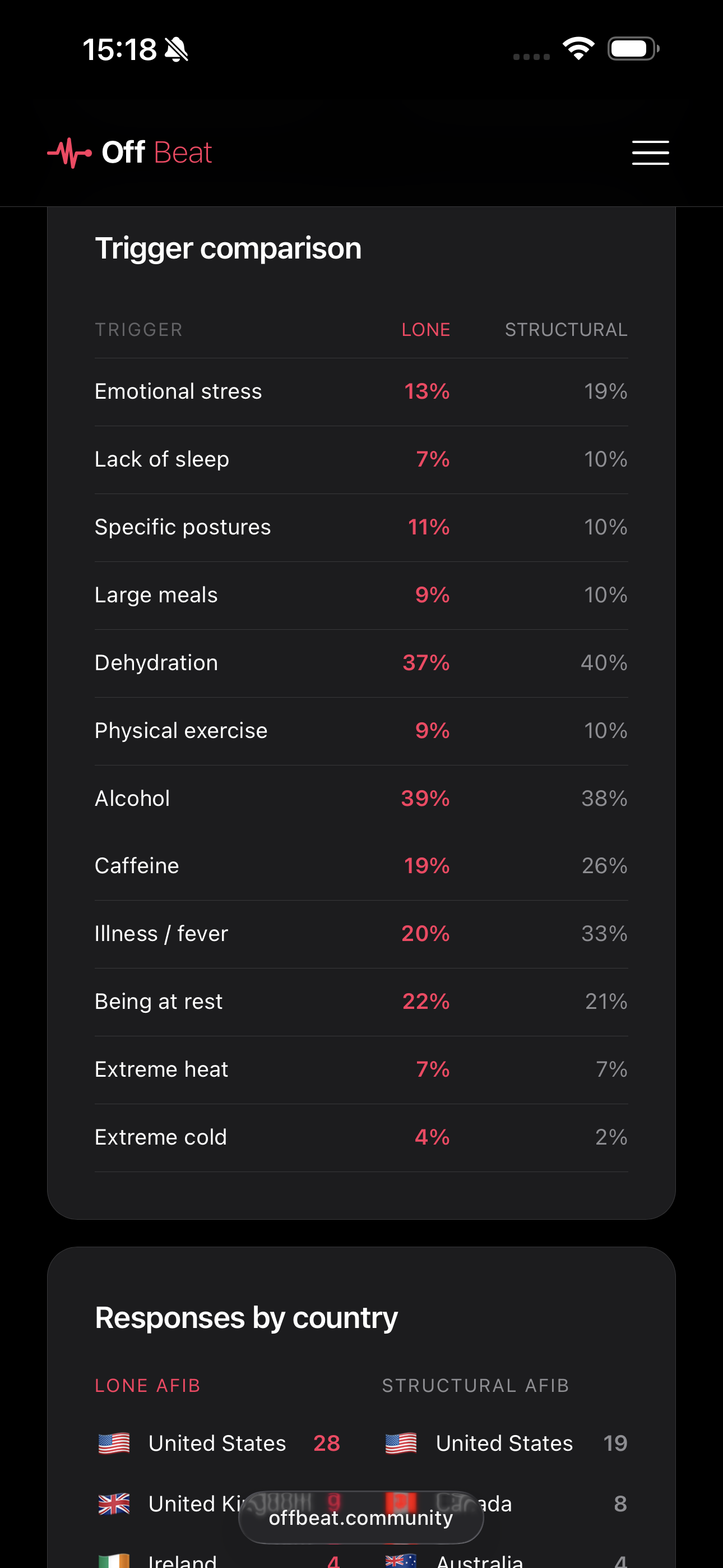
We currently have 96 responses from 13 countries. That’s a decent start, but it’s not enough to draw meaningful conclusions. For a dataset to be genuinely useful, to identify patterns with statistical confidence, to compare subgroups, to say something meaningful to a cardiologist or a researcher, we need scale.
The target is 500 responses. At that point, we can start to make claims that hold up. We can say, with confidence, that a certain proportion of young AFib patients with a particular profile respond well to a particular intervention. We can compare lone AFib to structural AFib. We can look at the pregnancy data, the fitness data, the mental health data, and find signal in the noise.
Until then, we keep collecting.
Stage 2: Find what’s actually helping
The survey is the foundation, but it’s not the whole picture. Numbers tell you what, but they don’t always tell you why.
So alongside the data, we’re building three parallel streams:
The survey data itself. As responses grow, patterns will emerge. Which symptom management strategies are most commonly rated as effective? Who are they working for, and who aren’t they working for? What does the fitness profile of someone who’s returned to full exercise look like compared to someone who’s stopped completely?
Interviews. We’re already identifying respondents who are willing to be interviewed. These are people who’ve navigated this well, people who’ve struggled, people whose stories contain something useful. These conversations will sit alongside the data and bring it to life.
Expert input. The data will form the basis of conversations with electrophysiologists, sports cardiologists, psychologists, and others who work with this patient group. We want to take our findings to them and ask: does this match what you see? What does it mean? What should we do with it?
Stage 3: Put the findings to work
This is the part I care about most.
The findings from Stage 2 feed in three directions.
The community. People living with AFib — particularly young, active people who feel like they’ve fallen through the cracks of a system designed for older patients — deserve to know that there are strategies. That they’re not alone. That hundreds of people in the same situation have found ways to manage, adapt, and in many cases thrive. Off Beat should be the place where that knowledge lives, clearly and accessibly.
Healthcare providers. GPs and cardiologists are often seeing young AFib patients in brief appointments, without much context for what this population actually experiences. A well-evidenced dataset showing mental health impact, exercise modification patterns, what’s helping and what isn’t, gives clinicians something concrete to work with.
Healthcare companies. There’s a growing ecosystem of products and services relevant to this group. Supplement brands, vagus nerve stimulation devices, wearable manufacturers, cardiac monitoring companies. Most of them don’t have good data on young, active AFib patients. We can change that. Not by endorsing products, but by helping companies who want to serve this community understand who we actually are and what we actually need.
The short version
Someone asked me what I’m aiming for. Here it is:
I want young people with AFib to feel less alone, better informed, and better equipped. I want the people treating them to have better data. And I want the companies building tools for them to build better tools.
That’s it. Everything else is in service of that.
If you haven’t taken the survey yet, it takes five minutes and every response genuinely matters.